
An 18-year survivor of a vestibular schwannoma on choosing hope, asking for help, and finding her community.
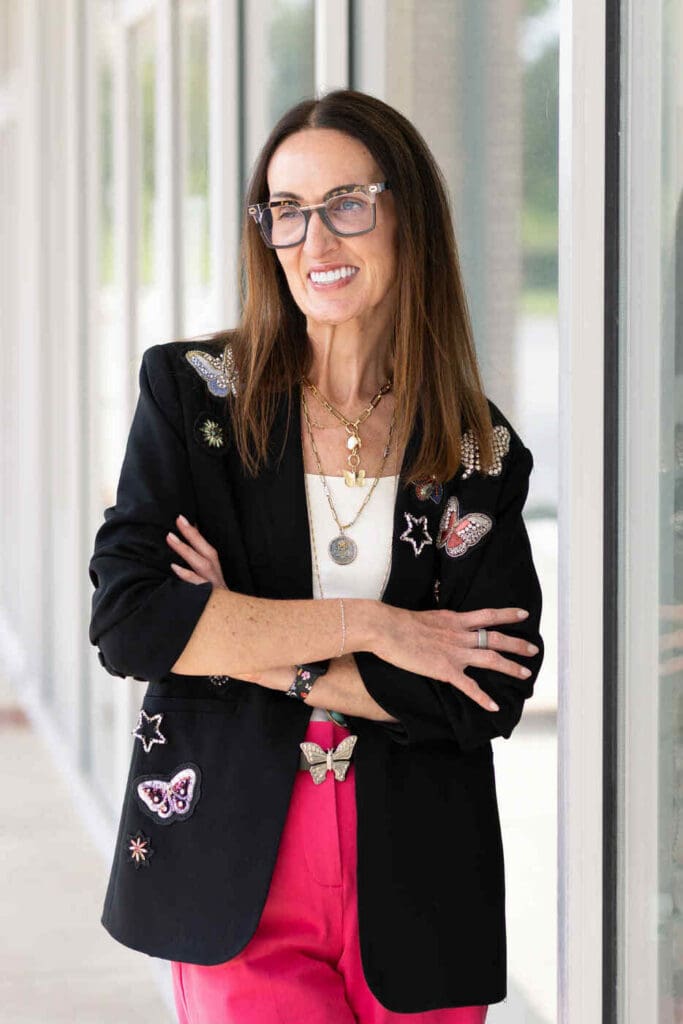
On the morning of April 14, 2008, CiCi Hope sat alone in a doctor’s office, waiting to hear why she kept waking up sick in the middle of the night. She was 33 years old, a vice president at a commercial real estate firm, a runner, and a true Atlanta native, born at Grady Memorial Hospital and proud of it.
The neurologist called her into his office instead of an exam room. She remembers his voice fading into a muffled hum, “like the Charlie Brown cartoons,” as he told her there was a very large mass in her brain.
“I was in disbelief. I felt like they weren’t talking to me,” CiCi said. “Anyone that receives the diagnosis, that’s how I felt. My world was shook. I just felt like I was kicked in the stomach.”
She made three phone calls that morning: her mother, her best friend, and her boss.
Two Golf Balls
The symptoms had not looked like a brain tumor, because almost no one’s do. Headaches. Changes in her gait. Waking up in the middle of the night vomiting. She had gone to her gynecologist first, assuming hormones were to blame. When tests came back clean, she was referred to a neurologist, who ordered an MRI.
Claustrophobic, she put the scan off for a month. “Now I look at it in hindsight, I’m glad I got it,” she said. The results came back within the hour.
That same afternoon, she went to see a neurosurgeon and insisted on seeing the scan for herself. “That’s the type of person I am. I need to see facts. I need to see the results. I want answers.”
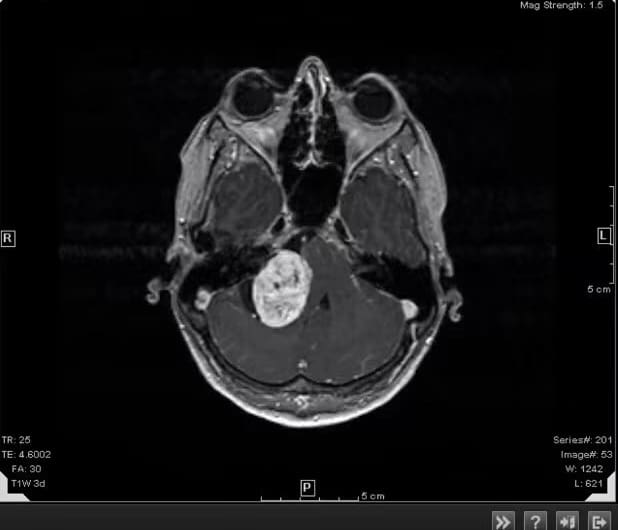
The diagnosis was a vestibular schwannoma, also called an acoustic neuroma, a rare tumor pressed against her brainstem. “It was two golf balls in size, in my head,” she said. “And that was unreal. Unreal for me.”
The first neurosurgeon she saw did not soften it. “He said, your type of tumor is so rare and dangerous, I would not operate on you if you were my wife or daughter,” she recalled. He handed her five referrals. She chose Dr. Jeffrey Olson at Emory University, which would also put her close to her mother, her grandmother, and her friends.
“When I met with Dr. Olson, I immediately chose him. He was very matter of fact, no nonsense. And that’s what I needed.”
Fourteen Hours
The surgery was supposed to take eight to 10 hours. It took 14.
Surgeons could not remove all of the tumor. Part of it remains wrapped around her brainstem to this day. Five days after surgery, still in the hospital, CiCi suffered a stroke, the first of four she has endured. She spent a solid month between the hospital and inpatient rehabilitation.
“I had to relearn things such as walking, some speech, and buttoning my own shirt,” she said. “Things that most people take for granted. I still get tearful today thinking back.”
The years since have brought more: deafness in her right ear, tremors on her right side, facial paralysis, and two corneal transplants that both rejected, leaving one eye legally blind with a painful condition called neurotrophic keratitis.
“Some of it will always remain, wrapped around my brainstem, and that’s simply my reality. But it is not my identity.”
Learning to Ask for Help
Ask CiCi about the hardest part of recovery and she does not talk about the operating room. She talks about a glass of water.
“I’m such an independent person. To have to rely on help, and ask for it, I didn’t know how to do that,” she said. “I had to learn to say, I need you to get a glass of water for me. I need you to take my dog for a walk. Those are things that honestly frustrated me, not being able to do them.”
It was six months before she could drive again. The diagnosis eventually cost her the career she loved, and the home she was living in, which she had not yet had the chance to buy when the diagnosis arrived. She moved and rebuilt, one borrowed hand at a time.
Finding SBTF
About a year after surgery, CiCi found the Southeastern Brain Tumor Foundation, and she has been a part of SBTF ever since.
The support has taken many forms over the years: support groups, community, and, when she needed it most, direct financial assistance. As a single woman unable to work because of what she calls an invisible disease, the small things are not small.
“There’s such great courage among everyone involved with SBTF. You can reach out to anyone, and everyone is willing to lift a hand,” she said. “Something as simple as paying a power bill means the world. We all need our power.”
She keeps coming back to support groups, even after 18 years. “I feel like I learn something every time,” she said.
Becoming Hope
Hope, for CiCi, is not a soft word. She grew up in foster care and was adopted at age 16. “I worked my rear end off to get to where I was, and I’m grateful for where I am today,” she said. “So it is a mindset. I can be down in the dumps, and I can choose not to be. It is a choice.”
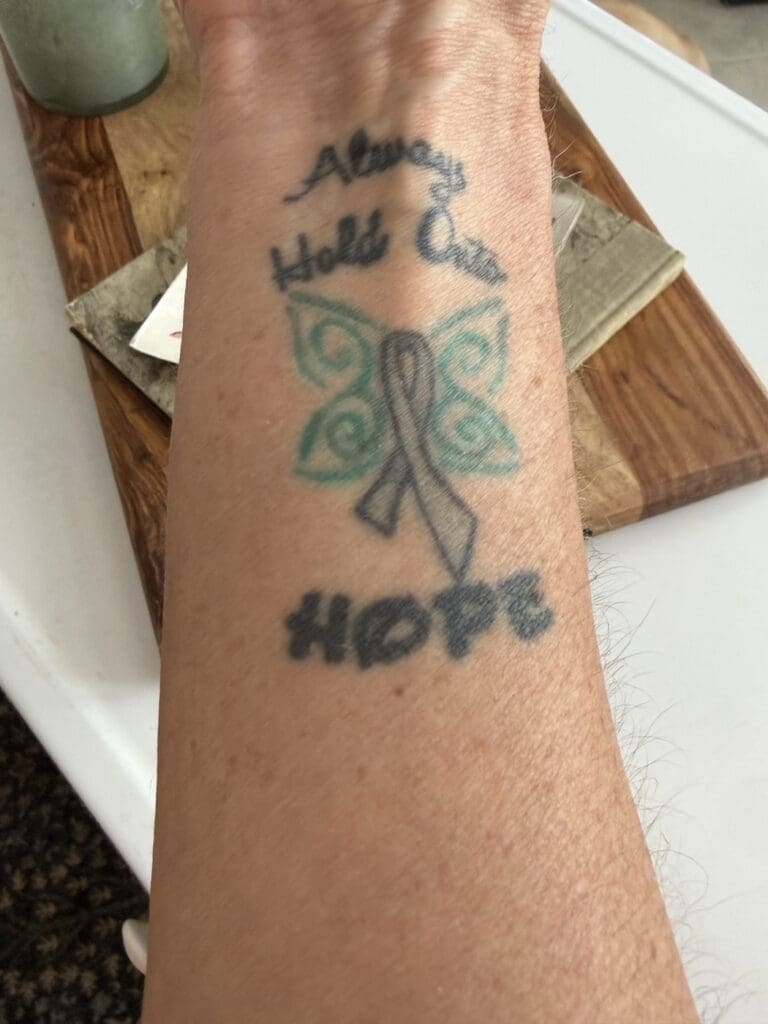
Her tagline, #AlwaysHoldOnToHope, is tattooed on her arm. Asked how a person actually does that, she paused for a long moment before answering.
“Always find gratitude in something. Because there’s always something to be grateful for.”
The woman who once ran races and was involved in commercial real estate now measures life differently, and she is at peace with the exchange. “I look forward to every day. Every day is a new day,” she said. “I like simplicity now. The littlest things make me happy. I want to take each step, each moment, and be grateful for that.”
Art and fashion, passions since childhood, are still how she stays creative. “You find new ways to do things,” she said. And to anyone whose diagnosis takes the career they loved, she offers this: “There’s something better. Even eighteen years later, I still find something creative to do. Everything happens for a reason.”
Eighteen Years
CiCi sat for this interview on July 24, exactly 18 years after her surgery. A week later, on the anniversary she calls her “crainversary,” she shared this reflection with her community:
“Eighteen years ago, my life changed forever. What started as a 14-hour brain surgery became a journey I never could have imagined. It cost me a career I loved, changed my body, and forced me to redefine what ‘normal’ would look like. But here’s the thing. I’m still here.
I’ve learned that surviving is one thing. Thriving is a choice.
Life is incredibly fragile. Don’t wait for ‘someday.’ Tell people you love them. Chase the dream. Take the trip. Forgive. Laugh louder. Give more.
Still standing. Still fighting. Still thriving. Still a warrior.”
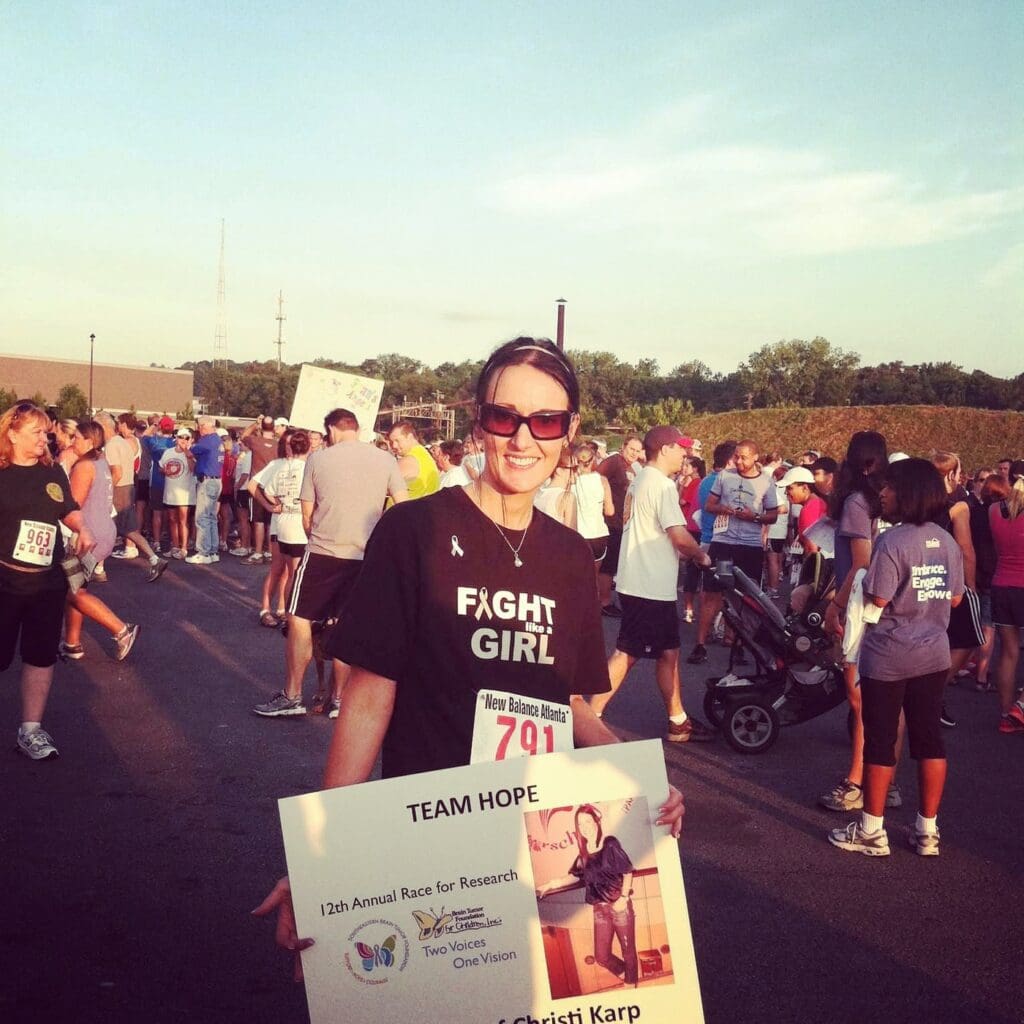
These days CiCi gives back to SBTF every way she can, and she is already asking her doctor whether a stress fracture will keep her off her feet for this year’s Race for Research. Knowing CiCi, she will find a way to be there.
You can follow CiCi at @hopecici19 on Instagram, Facebook, TikTok, and Threads.
Every brain tumor story is different, and no one should walk theirs alone. Find an SBTF support group, or register for the Race for Research. And in every season: always hold on to hope.
Donate to fund research and patient support